Super Intelligence seems to want all your money
Ok, this post will cover one of the biggest questions currently - will the global demand for AI use cases continue to rise in the future? I primarily wrote this for my own need to sort out my thoughts in order to act on certain things. I am sharing my reasoning below.
So, how much useful intelligence will we eventually want to pay for?
Demand state so far
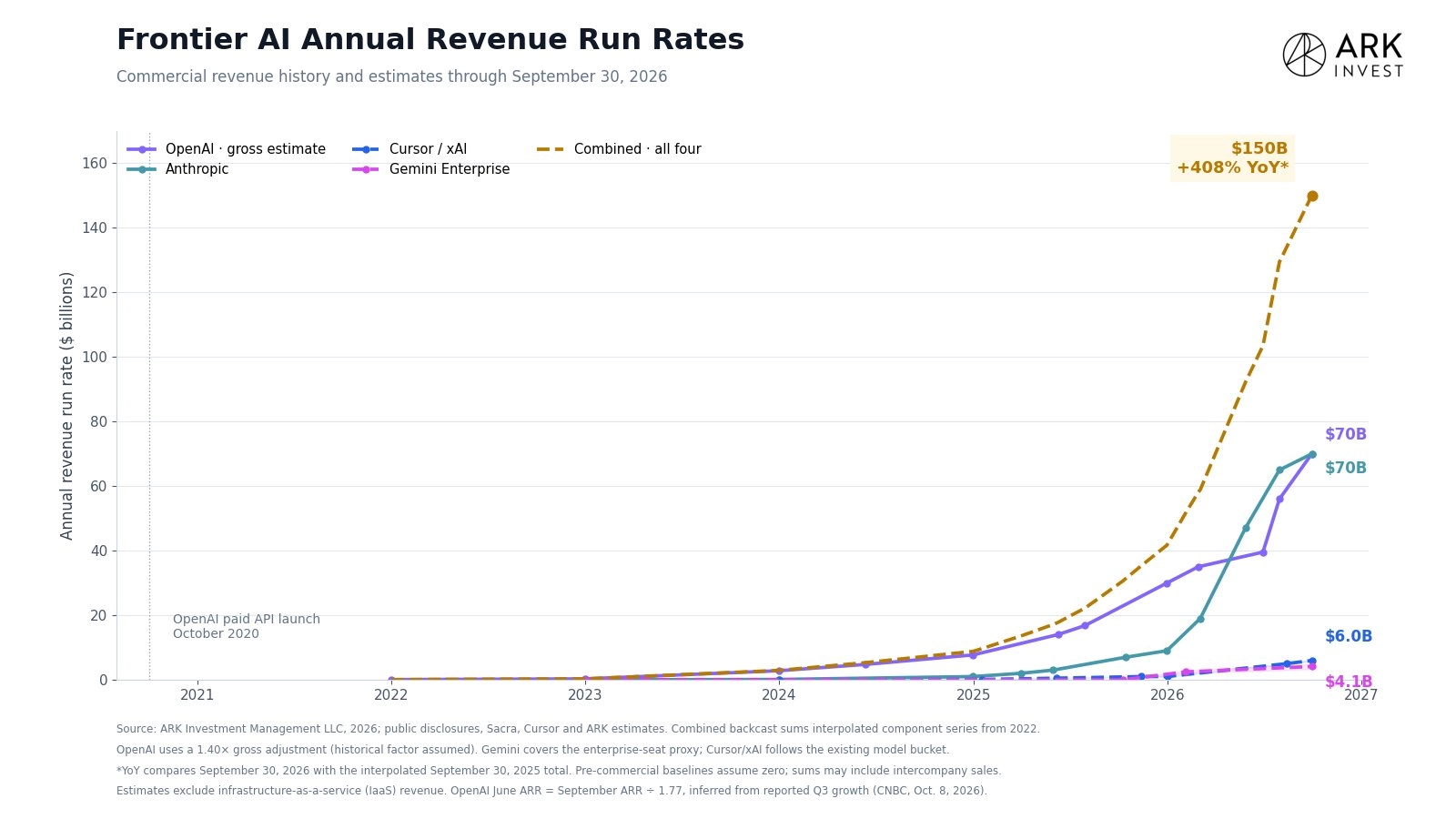
In the last 3-4 years, the demand for AI tokens has exploded. And with that, so has the revenue of the biggest AI model companies.
What caused this token demand?
What people mean when they say they are “using AI” has changed over the last few years. This also changed where the most demand was happening. Here are the phases that one can go through:
Instant LLMs
If you remember when ChatGPT came out, the model behind it was GPT-3.5, which was one of the classical LLMs. Those worked in a way where when you asked a question, it would give you an instant answer.
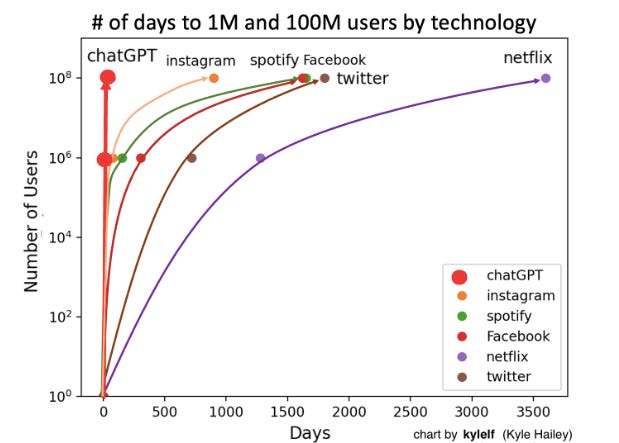
And this was amazing! The ChatGPT application was extremely useful and it had enormous growth (reaching one million users in just five days!). So many people who used it found great practical use cases and it started to spread like a wildfire. The AI boom started 💥
Reasoning Models
Then reasoning models came onto the scene. Here, instead of giving an instant answer, a model could “reason” (think) before replying. This improved model capabilities across many domains, and people started finding new use cases, where previous instant LLMs could not work. All of this resulted in a new paradigm - inference-time compute - and much greater demand for tokens which meant a need for more graphics cards in order to enable models to “think”. Companies like Nvidia started to report (additional) enormous revenues since everyone needed so many of their cards to meet the demand.
The demand saw a huge new wave of growth, and the effect of reasoning models on expanding AI’s usefulness is still extremely high.
Agents
And then, we got agents. The word agent has started to become a synonym for Artificial Intelligence. Almost everyone is mentioning agents when they are talking about AI. Btw the best AI labs warned us about this. They said “2025 will be a year of agents”. It turned out that they were just a few months off. A lot of people got to experience the agents for the first time in 2026 and to those who tried them, it became obvious that we will live in more than just one year of this new paradigm doing work.
One of the most important characteristics of agents is that they are LLM models that can use tools. It is actually the loop where an AI model takes an action, receives the result, decides what to do next, and continues until it finishes or needs help. This means that they interact with the digital environment you put them in. They can create new files on your computer, edit documents you started, use your browser and so on and so on. And this agentic loop that they do requires more tokens than a standard answer you were getting previously.
Agents took jobs like Software Engineering (SWE) by storm. They completely changed how work is done, and many software developers now do not write code themselves. This changed our field so much that many of our younger colleagues who recently got into the field are wondering if they even need to learn to write code at all.
Regardless of what a developer’s main focus is in their daily work (a whole new separate topic), one thing is certain: in the SWE field we can without a doubt see the “stickiness” of intelligence. If you ask around, so many people say that they can not imagine going back to “old ways” or writing code by hand. And this stickiness phenomenon is something we start seeing across many fields and professions.
The main point is that when you get used to help/assistance/work from a specific level of intelligence, it is really inconvenient transitioning to lower intelligence, or no intelligence at all. And this “human inconvenience” has always been a great driver for demand. In this case - AI demand.
Multi-agent systems
Frontier AI companies, of course, immediately started using multiple agents to work on the same problem. After the models that those agents were using became Falling model costsFalling costs are making it easier for individuals to experiment with this too. For example, when Anthropic released Opus 5.5 in September 2026, input and output token prices were 20% lower than Opus 5, while Anthropic reported 40% lower costs on typical workloads., many individuals started doing the same thing. We started getting new ideas on how to use those agents so they work better together. Some started being used as planners and coordinators, others as workers, and some as reviewers. “Multi agent orchestration” became a term that you can now hear more often, and that actually has a practical day-to-day usage.
But you can also imagine the cost of using those “swarms” of agents. Earlier we were talking about using one model that could be more or less expensive, then reasoning models added a cost, then agents started being able to use tools and interact with the environment. And finally we can just have tens or hundreds or even thousands of agents working on solving problems.
Wide scale
To summarize the above: We talked about something that can be called “AI adoption stack per task” and it looks like this:
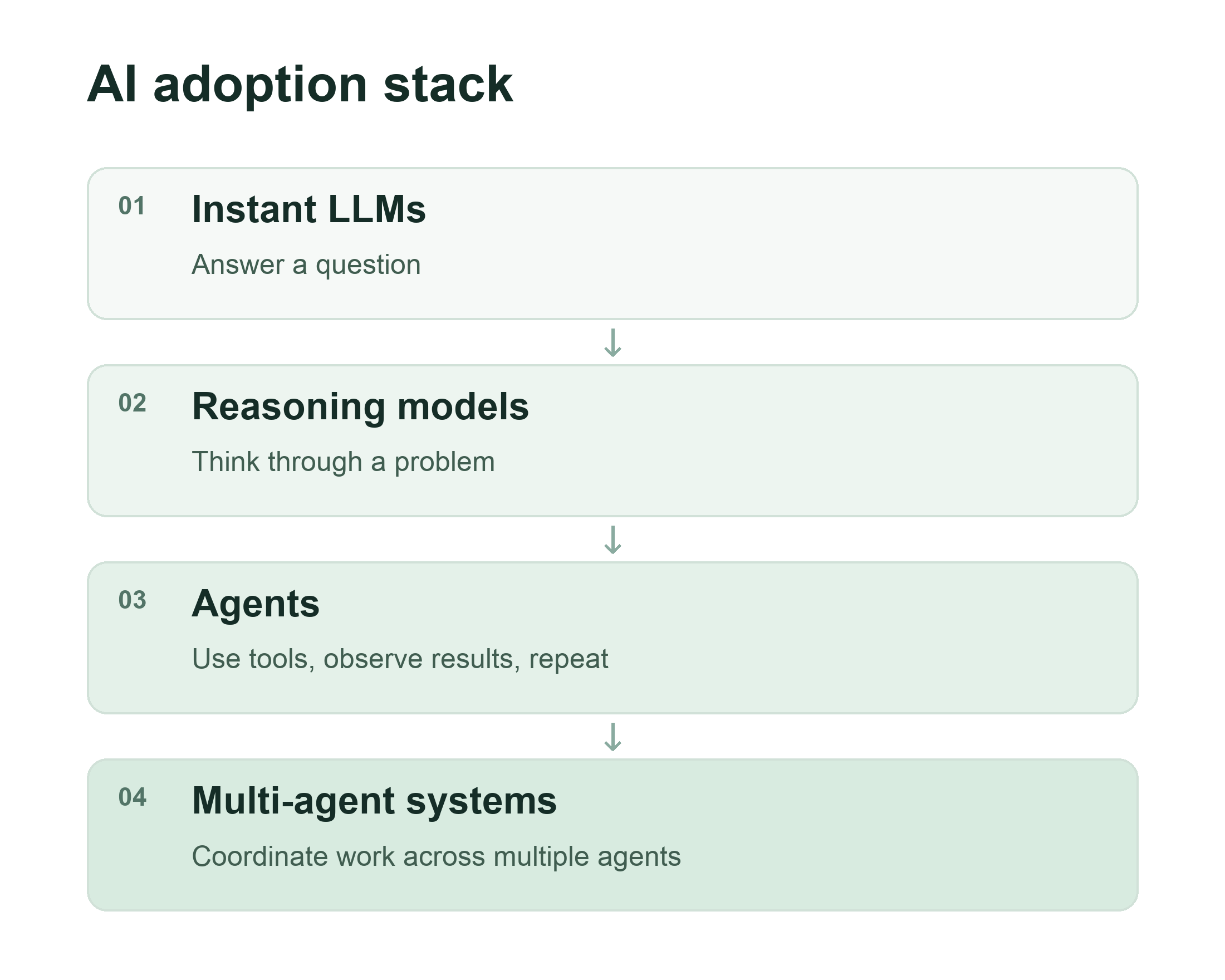
In most cases, by going down the stack, the token consumption grows. This is not to say that all problems require thousands of agents. Some of them can be solved/satisfied with even an instant LLM reply. The main point is that we expanded the scope of how we can use AI, and individuals and corporations now have options to choose which one fits their need the best.
But if you notice, the chart above represents the layers of AI adoption per task. But it does not talk about the general population-level adoption of AI technology. When one person goes from using a reasoning LLM to the agent-based AI usage, it does not have anything to do with 99 people next to them who use Instant LLMs or not use AI at all. And then this is again completely different than 50 people out of 100 using AI, or 99 of them using it, or all of them. The more people (or companies) use AI, the greater token consumption is, independent of level of usage.
And when we look at AI adoption in the general population, there is still a lot of room for growth. In June 2026, around 18.8% of the world’s working-age population used generative AI (consciously). A lot of people still use AI just in a browser, and only recently we’ve seen a clear trend in the adoption of AI Agents in coding. JetBrains research found that Claude Code usage at work increased from 18% of professional developers in January 2026 to 39% in May–July, while Codex increased from 3% to 16%. Multi-agent orchestration is still far away from full adoption even in a lot of the software development teams, not to mention the individual users. But it is interesting that with good consumer-based products (GrokBot, Muse, Instinct), this is starting to get traction as well!
Where the future demand wave can come from
My thesis on where we should expect the growing demand for AI tokens consists of expanding into multiple different directions. I don’t expect all of these directions to develop at the same pace. Here are a few of the most important ones:
Moving down the AI Adoption Stack
I think everything we do digitally will converge towards “agentic interfaces” where you describe the goal and let some system handle it for you. Sometimes it will be important what that system is and how it works, but I see a lot of cases where it won’t. You will just care about the work being done reliably in the requested manner. This means that we will demand a lot of autonomous work, where, depending on the problem, multiple agents can collaborate, brainstorm, correct each other, and then deliver the final answer or solution behind the scenes.
Of course, these systems will almost certainly be more efficient in terms of intelligence cost and may need fewer resources for the same work, but people then will be able to delegate more work because it becomes useful and affordable. They may also attempt work they previously couldn’t justify. My bet is that the additional work people choose to delegate will more than offset the efficiency gains on existing tasks.
Scaling AI Adoption Stack to more industries
In the same way that using AI agents (mostly single agents) is now widespread and utilized in, for example, the SWE industry, I expect many industries to follow. A few of them already do and the usage rises continually, but I am talking about ALL digital industries adopting this technology in one way or another, on a scale where every employee of a specific company is using it, in a similar way to how they use the Internet today.
Frontier Intelligence for hard problems
On a humanity-level scale, we have a lot of problems that we need to solve. Cure cancer, solve practical energy scaling, grow resistant healthy and nutritious food everywhere, find room temperature superconductors, and so many others. We would all like to see them solved as soon as possible. With new AI models/systems we get to see the early signs of speeding up the path to those solutions. We do not have them yet, but people who work on them constantly talk about how they use AI to help them progress.
And since those are some of the hardest problems we have, it is very likely that they will require the best AI models/systems that we have. You will not need GPT10 to help you cook your lunch for that day, (current models have interesting taste already 😋) but some biomedical company that uses AI to demonstrate progress and produce valuable results will require all the intelligence it can get in order to, for example, understand how a potential treatment interacts with its biological target.
This is just one example. Imagine pushing the limits of every scientific discipline with the highest form of intelligence we can get our hands on. The AI demand here can be a category on its own.
Physical intelligence
Physical intelligence can be a topic in itself because its real potential is probably even higher than that of digital intelligence. You can think of it as the ability to manipulate physical stuff. That does not mean just moving boxes around. That includes folding the laundry, but also autonomous driving, food growing and picking, construction work, performing a surgery, and basically everything else you see people around you do in the physical world.
If we are going to have robots do those, they will need a lot of intelligence behind the physical movement that will represent the “thinking” robot does before performing the action. There will also be “an AI agent” in charge of whatever the physical shape of the robot is. It is just that the real world physical environment is much more difficult to navigate with precision than the digital environment our agents now operate in. But we also have early signs there:
Watch the Astra robot video on X
Now imagine thousands and then millions and then tens or hundreds of millions of general or specialized robots doing all sorts of useful work. They will need a lot of planning and actions for things like encountering unfamiliar tasks, interpreting changing situations, and recovering from failures. That’s a lot of tokens.
“The more I’ve learned in life the more I realized there is more to do”
A valid question one can ask is: “What guarantees that the demand will persist over the years?” And the answer is: well, nothing. That is why there is a lot of uncertainty in the market for how long the trends we have today can continue.
Also, there is an extremely high chance AI models will become more efficient, and the price per unit of intelligence will keep falling.
But based on everything listed in the section above, I think that it is very plausible that the token demand still continues to grow significantly. And then, on top of that, we should factor in the “curiosity philosophy” token demand.
Curiosity Philosophy
If you ask the general question “What do you need intelligence for”, one obvious answer is “to solve all my problems”. And that is a perfectly reasonable answer because there are always problems to solve. But to me, an equally interesting answer is: “I need more intelligence to know what challenges are best to tackle next”. Expanding your understanding of things around you, and figuring out what questions to ask, and what paths to pursue seems to be both in the spirit of our civilization, and also even harder than solving what we already know exists.
My thesis is that as we get closer to answering today’s most important questions, we will be able to see the questions in even more interesting directions, that will be at least equally important to solve. Both individually and on the level of the whole of humanity. And my assumption is that those questions will matter enough for us to keep directing more intelligence toward understanding and solving them. Super Intelligence may start solving “superproblems” (the ones we don’t even know exist yet, but are important), which by itself represents a whole separate demand space.
And if we take this to its absolute limit, the potential extreme scenario is where Super Intelligence is able to help you solve your current problems and help you understand where to look next, and all it requires from you is tokens. Imagine that exchange - you give it all of your money, and all of your problems get solved.
In that scenario, would you be ready to give the Super Intelligence all of your money? 😉
Get the next essay by email
One email when I publish a new blog post.
You can unsubscribe at any time. Powered by Buttondown.