The New Value of Bullet Points
The Ideas We Have
If you were to think about what separates humans from everything else on our planet, you would have a few things to list, but one of the most impactful advantages we have is that we can form complex ideas and plan around them. Not only we can create them, but we also learned to communicate them efficiently, which enabled us to coordinate and build everything we now see around us.
But there are different ways in which we communicate our ideas. The simplest one is of course speaking, as the most convenient way to make sure someone understands us. There is just one problem to it - speech is not permanent. So in order to make sure our ideas really persist, we came up with writing and reading, which took us some time, but it was well worth the effort. We can now absorb ideas others have spent their whole lifetimes thinking about with just a few touches of our finger.
But no matter the medium, there is one thing that is common for all of them, which is that all ideas start in a simple form. When the idea finally clicks, it is usually only a few thoughts we tied together, which we are then ready to expand. This first stage of the idea - its raw shape free of any “add-ons” - is what I call the Crux.
Crux of the Idea
We all love to read books, blog posts, or listen to inspiring speeches. But it’s not that they appear instantly. All of them started forming just as a few thoughts, the most important parts of the idea itself, that then expanded. The Crux of the idea is what remains when you remove all the “performance” around it.
Ideas spend a lot of time in their Crux form. It is actually the Crux of the idea that we play with, hypothesize about, restructure, or make sure it is valid. Why? Well because it is much easier to test the idea and confirm or deny it before we put the extra effort into extending it. The beautiful thing about Crux is that it can be summarized in a few bullet points. Anyone reading them can perfectly well get “the point” we wanted to communicate.
Once we know perfectly well what our idea is, only then it makes sense to commit to it more. This next, broader stage is what we usually get to read or listen to, and what ideas become known by. This stage I call “Extended Form”.
Extended Form
So Extended Form is the actual shape we get to consume the most. It is what we get after someone has already “polished” the Crux of the idea itself.
A good question here can be: “Why do we have Extended Form at all? Why don’t all ideas stay in their Crux Form?” One of the main answers is that the Extended Form carries important aspects with it. In the example of writing, some people have the ability to put words in just the right order, so that it greatly impacts the impression that Crux has on the reader. It turns out that the same Crux of the same idea can invoke a different emotion or action based on its Extended Form.
That’s why for the books, blogs, and other types of content, Extended Form is really important. Their authors don’t want you to just get the idea, but for the idea to leave a strong impression on you. In those cases, the Extended Form does not add just words. It adds understanding or emotion. That’s why great books, essays, and speeches matter - they move you!
I am personally always amazed by this skill of others to turn an idea Crux to an Extended Form in such an elegant way, where every addition actually improves your understanding of the idea or adds to a point it tries to make.
Most Communication Should Stay Closer to the Crux
But if we look at our everyday lives, we don’t usually write books or hold inspirational speeches. Most of our communication is pretty straightforward with the goal of transferring thoughts to one another that are related to simple points. Even if you have the board meeting that decides the state of your company, where people have different opinions, it is usually the Crux of someone’s idea that gets debated, not the Shakespearian version of its written form.
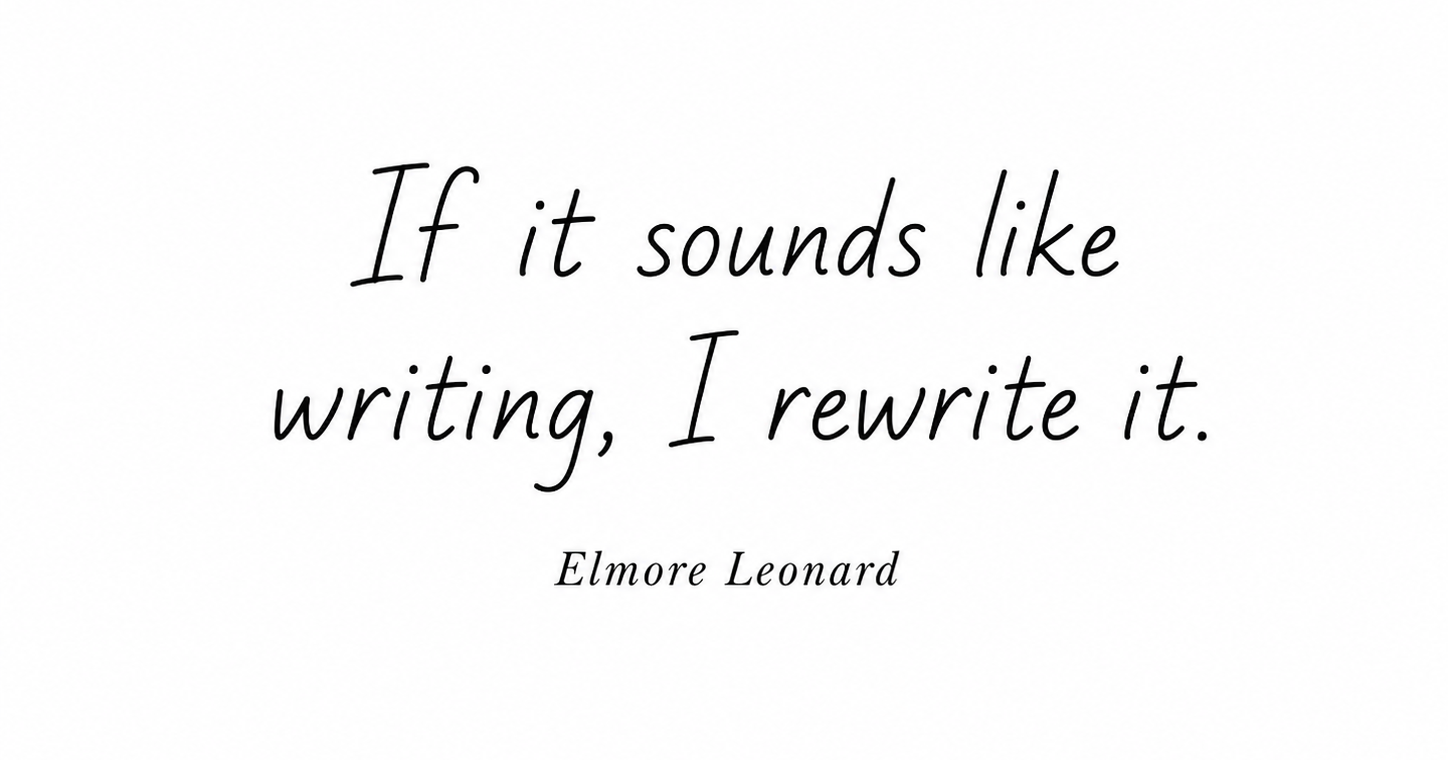
The Extended Form is crucial for masterpieces of literature, but it’s mostly unnecessary for short points we want to make on a random Tuesday. In fact, if our goal is to get the most out of the idea (especially in its early phases of formation), the best we can do is communicate the Crux and then discuss it.
On top of that, the Extended Form is not easy to consume. Adding extra words to your point does not automatically make it better. It usually just requires people who read it to put in extra effort to understand it. We have all been in a situation where you read some company memo or a LinkedIn post, and it is clear that the author “overpolished” the text. There is just too much of it, and the point would be clear without half of what is there. When someone “communicates in Extended Form” unnecessarily, it is not unusual that they just want to hide not having a strong understanding of the core of the idea, of its Crux.
You know the saying “You don’t understand something if you cannot explain to a child”. If you think about it, the saying basically says “You mastered something only when you can communicate the Crux of it, and people understand your point”.
Economics of Extended Form & AI
The process of going from concise Crux to Extended Form I call “Elaboration”, and so far it was not cheap! You needed to spend a good proportion of time to find the right word, to figure out the proper structure of your sentence and its rhythm, so that the tone is exactly as you’ve wanted. Also, every one of us has its own Elaboration style, that was really hard to imitate. It was not easy to “write as someone else”. Even the most prolific writers who wrote dozens of books were not easy to imitate when it comes to the style of their Extended Form.
But now, within the last 3-4 years, things got completely different. AI can now Elaborate in an instant, and it can do this almost indistinguishably from humans. You give it a brief summary (Crux) of your idea and it will generate a prose out of it in such a way that your fifth-grade teacher would be proud if your assignments were written in the same way. Writing emails in a formal way, or X has never been easier. Just say the word (to AI)!
Magical moment of first ChatGPT launch
In my opinion, this ability of early LLMs to Elaborate was a big part of this magical moment of ChatGPT launch. You remember those “write me text about X in a style of Y”. I think this was really interesting to a lot of people because AI was able to learn Elaboration process of so many different individuals, and spit out the Extended Form of their style almost instantly, right off the bat. It was literally trained in a way to learn (predict) this “style”.
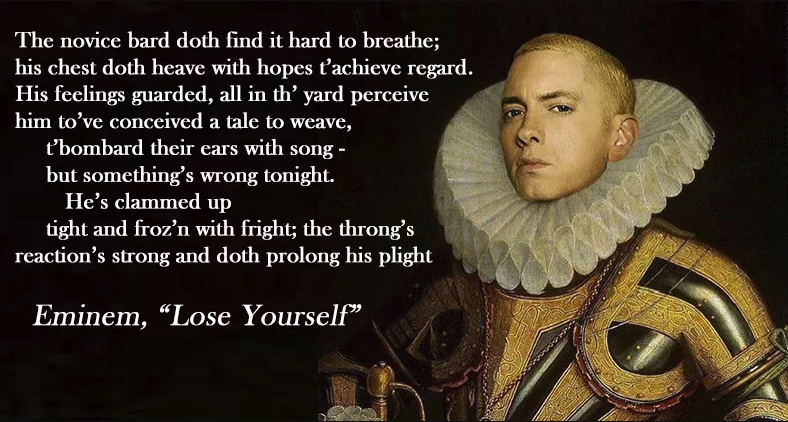
In this case for a lot of people AI for the first time demonstrated something genuinely new, and since we all think, speak, read, and write, and we know how hard it was for us to do it, everyone on the planet could understand this “miracle” instantly. And ChatGPT took off.
But it’s not all flowers and roses. There is a big downside of this cheap Elaboration. When something becomes abundant, it starts to appear everywhere. AI-generated Extended Form is now so widespread that we gave it a special name: AI Slop.
AI Slop
What we call AI Slop is not just bad writing. It is writing without strong substance. Or, using our terminology, it is Extended Form without enough Crux. AI Slop is an Extended Form that adds words without adding understanding. When you can spawn words instantly and without any cost, everyone does it, which makes distinguishing what is worthwhile reading from what is not much harder.
The problem is not length itself. We gladly read a 500-page book when it is written in a way where we know every page carries important meaning. But when someone copy-pastes the idea they saw, and then add the prompt “expand on this topic so that I can put it as the final document for my task X”, it defeats the purpose. Not only that, it is actually counterproductive, because the person on the other end could have done the same. As said earlier, we want to read the idea, not the “makeup words” around it.
Bullet Point Communication
Because of this dominance of AI-written text, what started to become valuable is a Crux-first communication, that I like to call Bullet Point communication. Bullet points are just a concise representation of a specific thought. Instead of writing 10 extra words to describe a 5-word idea, why not just put it in a bullet form as a one clear point.
You can see this form gaining popularity in a lot of places. One example is X network where posts structured as a series of > lines have started getting a lot more traction (so much so that even Sam Altman joined the movement).

Why? By reading them you instantly get the substance. They expose Crux directly. And, as I’ve mentioned above, in most cases we are interested only in this core part of the idea.
In the world where anyone can create Extended Forms instantly, the scarce thing becomes knowing what ideas are worth pursuing (having a good “idea taste”), knowing how to compress those ideas clearly, and also deciding when to use Extended Form.
Btw that is exactly the way I wrote this post. Here is part of the bullet-point Crux I wrote down while thinking through this post itself.
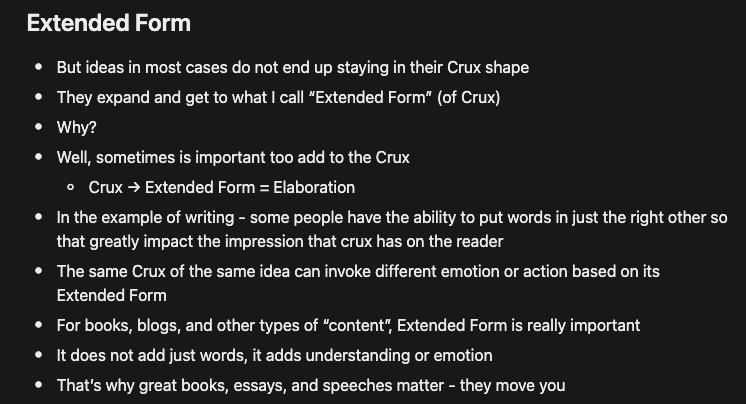
Only when I was happy with the bullet points I came up with, with their order and the points they represented, I started with Extended Form that you are reading now. The best part is, bullet points enabled me to iterate really fast, and to shape my idea, so that when I was finally pleased with what I have, writing the rest of the text did not take that much time.
The Elaboration was so much easier compared to when you are writing Extended Form from scratch.
The new skill
Bullet Point communication is now more valuable than ever. In my opinion, it will be one of those crucial skills to learn and use in a world flooded with AI-generated content.
When you write a text, instead of asking “Can I make it sound better or more professional or more stylish”, ask:
- What is the actual idea I want to communicate?
- Can it be compressed?
- Will elaboration improve it or hide its weakness?
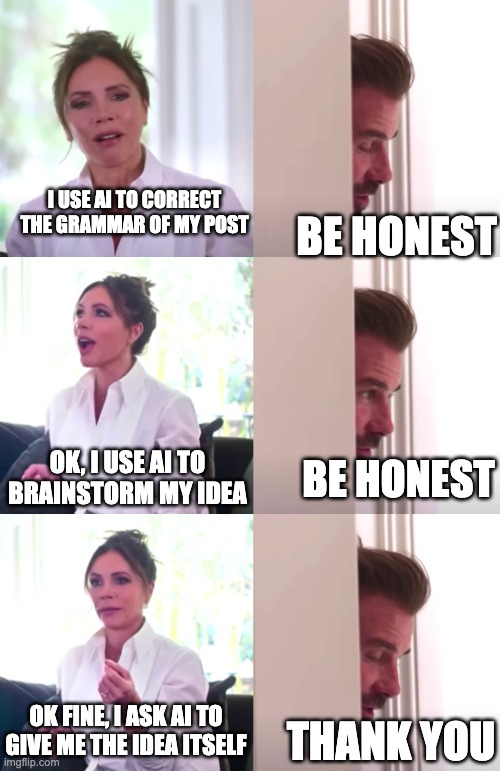
Of course, it is not a crime to use AI. AI can significantly improve many parts of the writing process. The main problem is when people start treating it as the replacement for the good idea and thinking around it to make it better and better. If you find yourself going to AI before you actually know what you want to write, maybe that’s a sign that you need more time with the idea itself.
And most importantly, always be honest with yourself.
AI made Extended Form cheap. That made the Crux even more important. Start with bullet points. Make your ideas bulletproof!
Get the next essay by email
One email when I publish a new blog post.
You can unsubscribe at any time. Powered by Buttondown.